Over 80% manage their project portfolio with multiple tools – 800 professionals share the reality
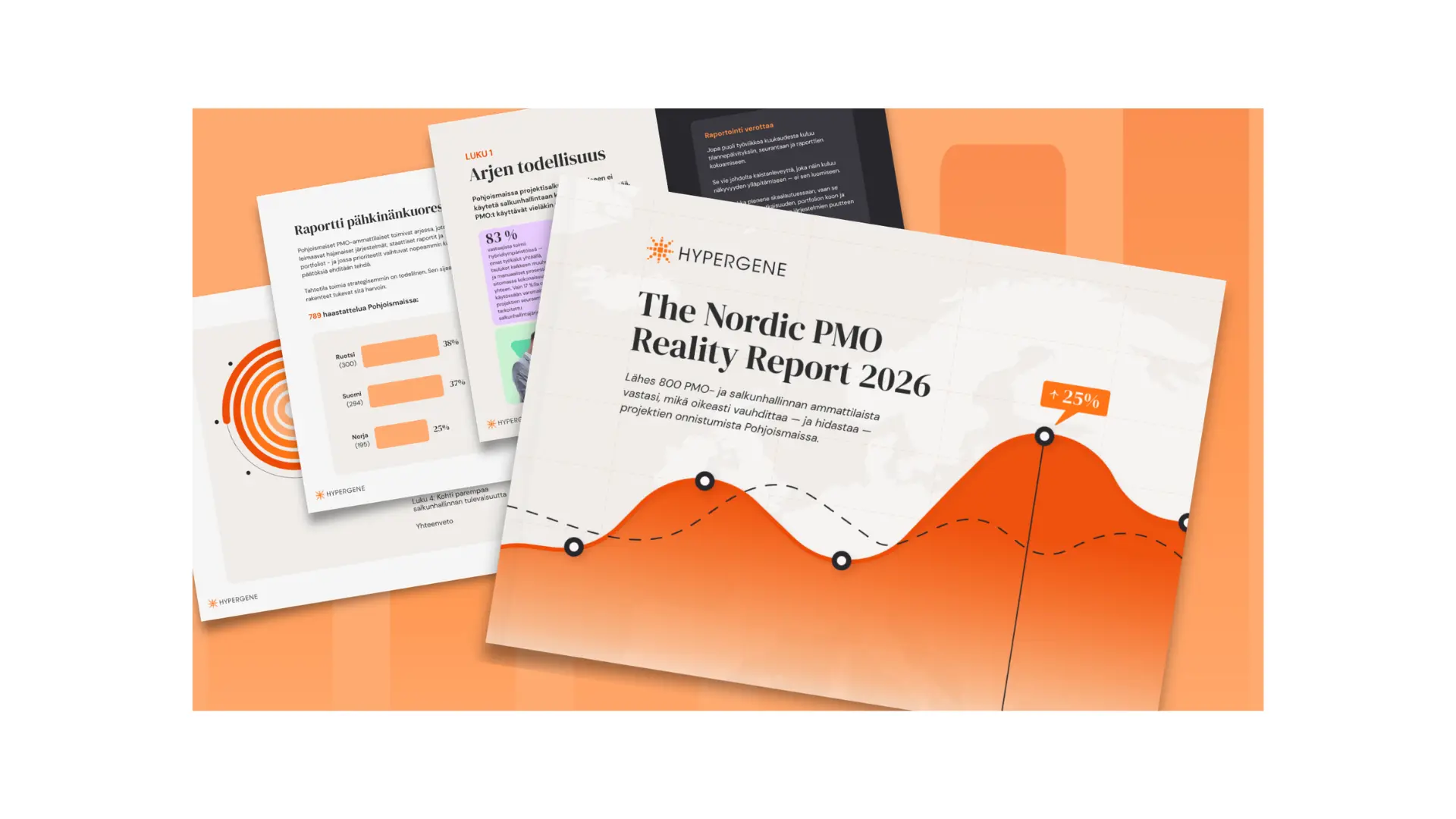
1. The hybrid trap – the same work is repeated across several tools
- A striking 83% of respondents check the state of their project portfolio through more than one tool.
- Over half rely on three or more tools to do it.
- Only 17% form the overall view through a single project portfolio management system.
"In practice this means information is scattered across various Excel sheets and different project tools. Very few have the full picture," says Marita Tuoma, Sales Lead at portfolio management specialist Hypergene.
Fragmentation leads to time-consuming and error-prone manual work, and building a real-time situational view is essentially impossible. When unified visibility is missing, sharing information upwards becomes difficult and managing the whole turns into heavy lifting.
Read how you can manage product portfolio with one platform
2. The leadership reality gap – decisions rest on partial visibility
The second major finding is the gap between operational teams and senior leadership. Across the Nordics, 34% of respondents feel leadership doesn't understand the real demands of projects. The result is strikingly similar in every country.
"Leadership underestimates how much time and resources projects actually require," Tuoma sums up.
Three themes stood out in the open responses:
- resources and time are too thin,
- complexity is greater than leadership assumes, and
- obstacles don't reach leadership in real time.
"On top of that, a significant share of respondents say they spend 2.5 days every month reporting on portfolio status – and some spend even more," Tuoma adds.
That means decision-making rests, at least partly, on data that's already outdated.
"Without real-time data, project professionals find it hard to justify needs to leadership – for example additional resources or changes to timelines."
"You could also ask what kind of progress could be made if that time went somewhere else," Tuoma points out.
The hours saved would ideally be spent on better resource planning, deeper collaboration with stakeholders, scenario planning and skills development. Notably, not a single respondent wanted to do more reporting.
3. The PMO earns a seat at the leadership table when project visibility is unified
The Nordic countries differ in how project professionals get to take part in strategic decision-making:
- The Finns see themselves more in a supporting role and further from leadership forums than their Swedish and Norwegian colleagues.
"In Finland, project professionals are clearly more executors – they deliver projects in line with strategic guidelines, but they don't take part much in shaping the strategy itself," Tuoma describes.
The gap is also visible in how project impact is measured. Only 16% of Finnish respondents say they measure the actual business impact of projects. In the other Nordic countries, attention shifts more strongly to the strategic impact of the work.
A clear explanation lies in the use of a unified portfolio management system:
- When the organisation has one shared view of every project, the people responsible for the portfolio are far more often involved in strategic decisions.
- Respondents with a project portfolio management system in place were twice as likely as others to say they can support leadership in strategic decisions – thanks to reliable, real-time data.
- They also work close to leadership day to day.
4. Burnout stems from uncertainty
The fourth finding from the Nordic survey is worrying. A lack of overall visibility – and the inability to grasp the rationale behind leadership's strategic decisions – translates directly into wellbeing. The weaker the dialogue about project status between project teams and leadership, the more likely burnout becomes on the project side.
"This was a striking result. As many as 30% of respondents felt their work had been exhausting over the past year. And the reason was that they were working across several systems," Tuoma says.
Put the other way: those using a unified portfolio management system are more likely to feel they get clearly more energy from their work than those without one.
The findings suggest that by securing visibility into every project, an organisation can direct project professionals' time more sensibly, improve predictability, and increase employee satisfaction by strengthening their sense of control.
"A project portfolio is also a communication tool. There should be transparency across the organisation into what's happening with projects."
Would you like to know how Hypergene can help you?