Confessions of a Nordic CFO 2025: What finance leaders won't say out loud
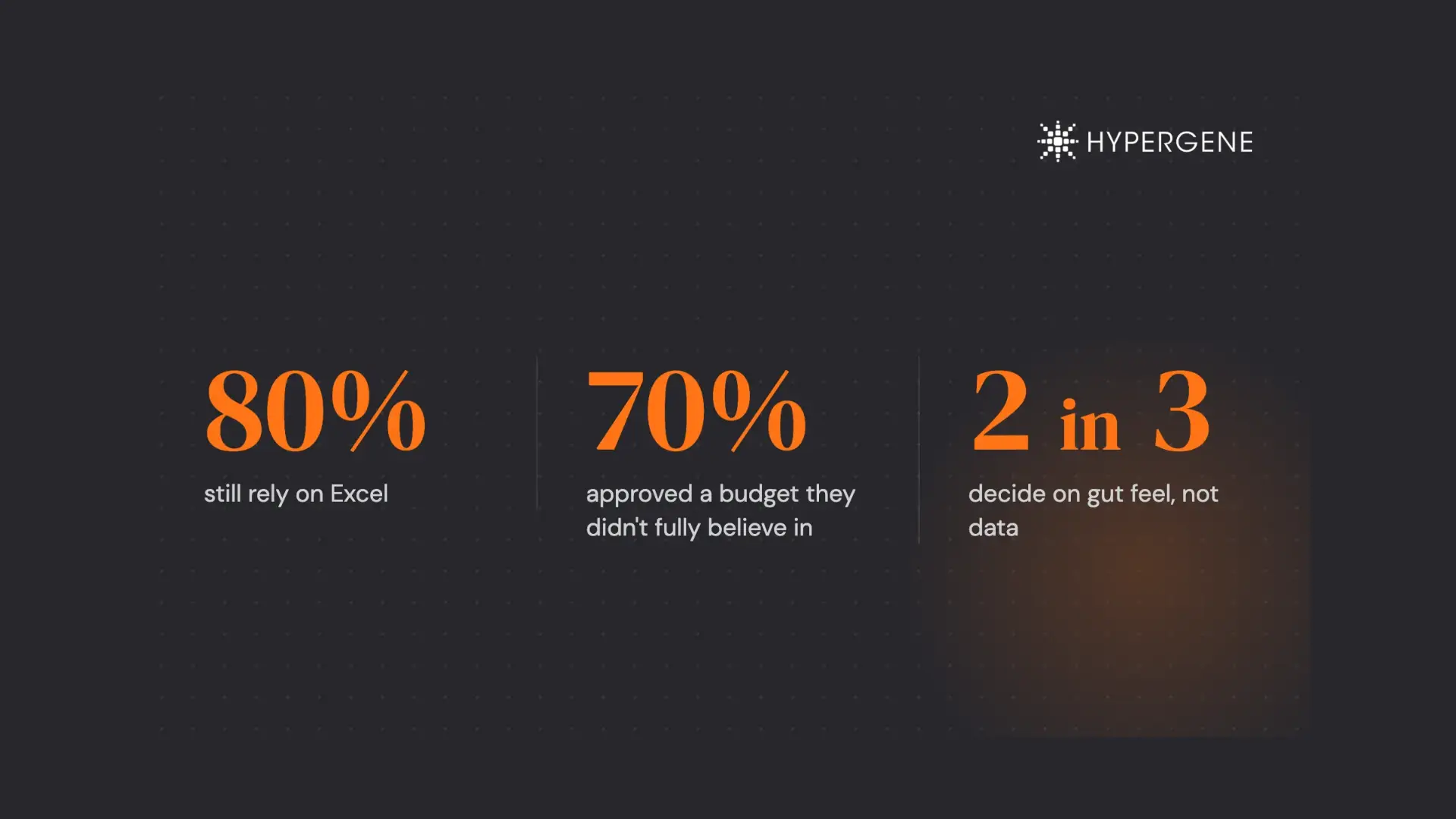
The Nordic region's largest CFO survey — 438 finance leaders across Sweden, Norway and Finland — reveals an uncomfortable truth: even in 2025, most finance functions still run on spreadsheets, most CFOs have approved budgets they didn't fully believe in, and two in three make decisions on gut feel because the data isn't there in time.
Finance leaders are ambitious. They want to be strategic partners for the business. But the day-to-day reality — scattered spreadsheets, late nights double-checking data, forecasts revised before they ever reach the board — keeps pulling them back into control work. That's the central finding of Confessions of a Nordic CFO 2025, produced by Hypergene.
This article presents the key findings in English for the first time — and what they mean for how finance teams plan, forecast, and decide.
What is the Confessions of a Nordic CFO report?
Confessions of a Nordic CFO 2025 is the largest CFO study in the Nordics, based on 438 interviews with CFOs and finance leaders in Sweden (54%), Norway (22%) and Finland (24%). The research was conducted in September 2025 via Norstat and Syno, independently of Hypergene. This article presents its findings in English; the full study was originally published in Swedish. It captures how finance leaders actually work — the pressure, the ambition, and the gap between the two — at a time when AI and macroeconomic volatility are reshaping what's expected of them.
The headline findings
- 80% of Nordic CFOs still use Excel — and 53% combine it with two or more other systems, creating extra work and more room for error.
- 70% have approved a budget they didn't fully believe in. 28% have done so more than once; only 27% say they never have.
- 87% see their forecasts revised or questioned before they reach management. Just 1% say it never happens.
- 2 in 3 (66%) make decisions on gut feel rather than data — not from a distrust of analysis, but because the data arrives too late or is fragmented.
- 41% say double-checking data is their single biggest time drain.
- 23% name AI as the most important driver of the next three years — but nearly as many cite uncertainty and lack of knowledge as their biggest obstacle.
Not a single respondent said they would spend extra time on "more reporting." The message is clear: finance leaders know where the value is — they just can't get to it.
Chapter 1: The spreadsheet love-hate relationship
Excel isn't just a tool in Nordic finance — it's a way of life. 8 in 10 CFOs use it. Asked to describe the relationship:
How CFOs describe their relationship with Excel
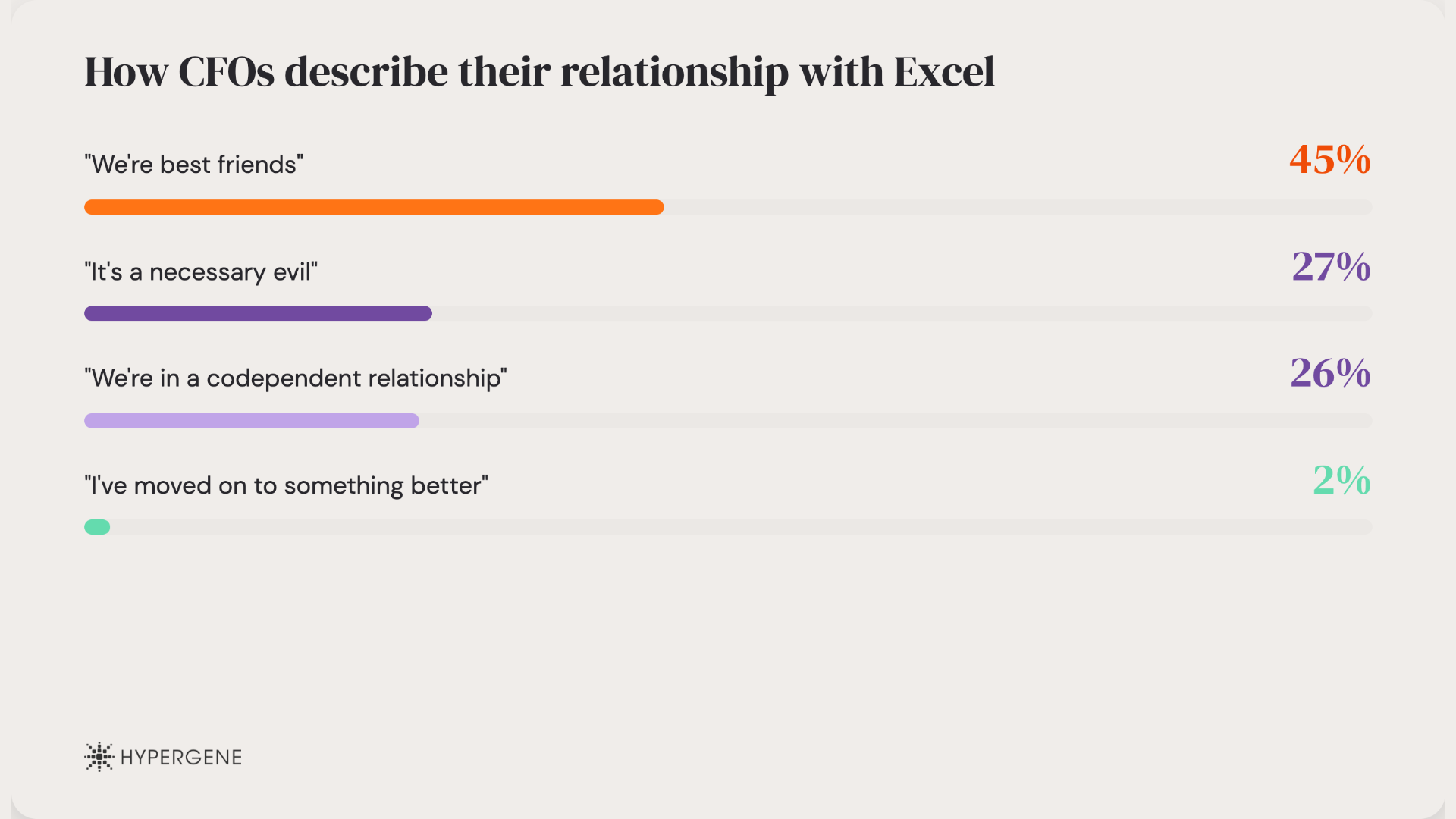
The affection varies by country. Norway is the most Excel-romantic (55% call it their best friend), followed by Sweden (44%) and Finland (40%). Finland is most likely to call it an unnecessary evil (33%).
But Excel rarely comes alone. 53% combine it with two other systems, 22% with three, and 14% with four or more. ERP modules exporting to spreadsheets, FP&A tools feeding Excel, home-built workarounds holding it together — the result is greater risk, more data errors, and duplicated work.
"The fact that spreadsheets still dominate in 2025 is frightening. It means things are moving far too slowly in Swedish finance departments."
— Dennis Lodin, CFO, Universum
Where the time goes
The top three time drains, according to CFOs:
- Double-checking data — 41%. When systems don't talk to each other, efficiency drops.
- Last-minute changes — 40%. Back and forth, different versions, new perspectives.
- Outdated tools — 30%. The "temporary" fix from five years ago isn't so temporary anymore.
Asked what they'd do with 10 extra hours a month, CFOs pointed squarely at strategy: strengthen collaboration between finance and the business (47%), develop the team (36%), scenario planning (26%), risk modelling (25%). Nobody chose "more reporting."
"The challenge isn't a lack of data — it's that the data lives in silos. As long as we lack a shared picture of reality, the CFO role will stay more controlling than strategic."
— Espen Sannerud, CFO, 3 Norway
Related: When are spreadsheets no longer enough for FP&A? and What is the difference between spreadsheets, ERP and an FP&A system?
Chapter 2: Public sector vs. private — two worlds, same challenges
The survey shows clear differences between sectors — but the same underlying problems.
- Excel dominates both: 82% in the private sector, 73% in the public sector.
- Public organisations use ERP add-ons (32% vs. 46%) and dedicated FP&A solutions (29% vs. 43%) less often.
- Only 11% of public-sector CFOs feel fully prepared for scenario planning, versus 23% in the private sector.
- 30% of private-sector CFOs feel pressure to meet business targets, versus 16% in the public sector.
In the private sector, the CFO is often a business driver focused on growth and ROI. In the public sector, the role is more about stewardship — transparency, security, and compliance. Public organisations use fewer systems, which can mean simpler structure but less flexibility. Either way, the result is the same: the CFO spends more time on control than on strategy.
Chapter 3: The confessions — what isn't said out loud
"I approved a budget I didn't really believe in." Few want to admit it, but the data is unambiguous: 70% have done it.
Have you approved a budget you didn't fully believe in?
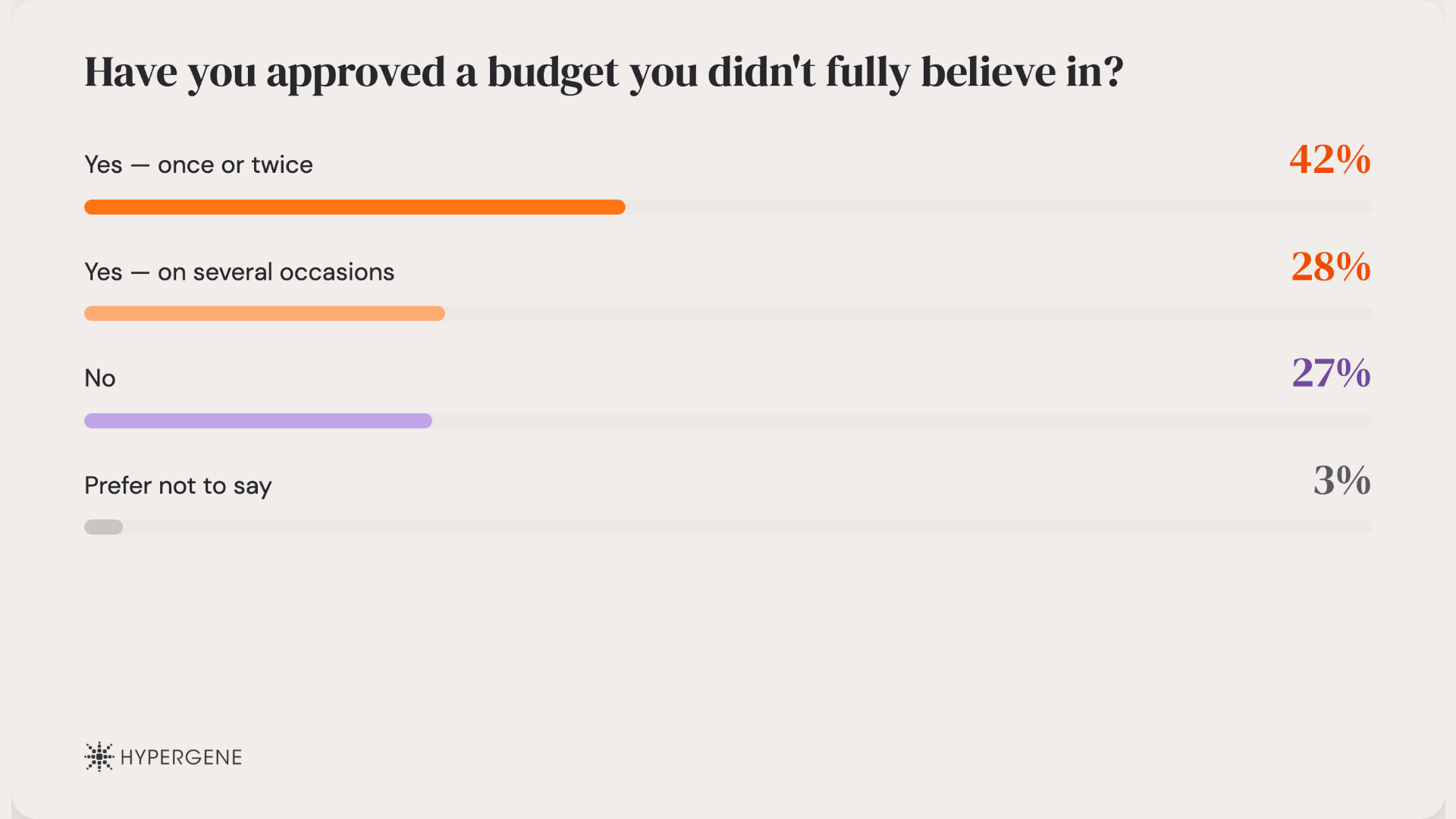
That's 307 of 438 finance leaders. Sweden leads on repeat offenders (30% "on several occasions"), Norway least often (24%). And there's a gender split: 32% of men versus 20% of women say they've approved a budget they didn't trust more than once.
"We want to contribute more strategically, but the reality is that much of our time goes into quality-assuring numbers. Our systems simply can't keep up with the pace the business expects."
— Espen Sannerud, CFO, 3 Norway
Forecasts — built to be changed?
87% say their forecasts are revised before reaching management. 13% say it happens every time, 35% "often," and only 1% say never. Nearly half of Nordic CFOs "often" or "always" have their forecasts questioned or changed before they reach leadership.
Company size matters: forecast changes are more common in larger organisations — 27% of companies with 100–1,000 employees say forecasts are always changed or questioned, versus 16% among smaller firms.
Related: Why don't CFOs fully trust their forecasts? and How do companies work with rolling forecasts in practice?
"I trust my gut."
2 in 3 CFOs make decisions on intuition rather than data. By country: Sweden 69%, Finland 63%, Norway 60%. By gender: men 68%, women 61%.
The most striking cut is by age: 90% of CFOs in their sixties say they decide on intuition rather than data. Is experience its own kind of data? Perhaps long careers and pattern recognition can outperform a spreadsheet. But the underlying cause is consistent — the data comes too late, is fragmented, or isn't there at all.
Chapter 4: The road ahead — AI, uncertainty and the strategic dream
AI is both the biggest opportunity and the biggest source of uncertainty. 23% name AI as the single most important driver of the next three years — and almost as many name uncertainty and lack of knowledge as their biggest obstacle.
Optimism varies:
- Private sector 24% vs. public sector 20% see AI as the top driver.
- Sweden is the most AI-positive (27%); Norway the most uncertain (17%).
- Women (13%) are more cautious than men (28%).
"Forecasting is hard these days. Even when you have a handle on the data, it's difficult to forecast a quarter ahead given macroeconomic headwinds and a fast-changing world."
— Dennis Lodin, CFO, Universum
The likely path forward isn't a single AI tool — it's a hybrid landscape with open integrations and better data governance, so AI can actually make a difference.
Related: How is AI used in FP&A in practice?
From number-keeper to strategic partner
What stops finance from being more strategic? CFOs were clear:
- Lack of integrated data - 37%
- Reporting takes too much time — 36%
- Lack of time and resources — 34%
- Lack of support from leadership — 22%
Related: How do you create a single source of truth in financial data?
Scenario planning: finance's Achilles' heel
Scenario planning is where ambition most often collides with reality. Just over half (53%) say they're fairly well prepared, 23% partly, and 4% not at all. Fully prepared, by country: Finland 25%, Sweden 20%, Norway 17%.
Small companies are least prepared (23%), while 49% of firms with over 100 employees have the processes in place — though they also carry more complexity.
"The ability to quickly create and adjust future scenarios becomes a competitive advantage. To succeed, we need to combine AI and human judgement — not choose between them."
— Espen Sannerud, CFO, 3 Norway
Related: How do CFOs work with scenario planning and simulations?
Conclusion: four choices that shape the future
To free up time, build trust, and become the strategic partner leadership needs, finance functions stand at a crossroads. The research points to four choices:
- Simplify the tool landscape. Well-integrated systems are the way forward. Disconnected systems steal time and create rework; a simpler landscape gives a unified view of the data — and more time for strategy over control.
- Automate routine work. Move from control to analysis, from reporting to strategy and decisions.
- Strengthen forecast quality. Accurate forecasts build trust across the organisation — and reduce the need to approve numbers on gut feel.
- Build AI capability. AI isn't about starting big; it's about starting now. Broaden the knowledge before competitors get the head start.
At their core, all four come down to the same thing: getting people, leadership, systems and processes moving in the same direction.
"Make sure the organisation, processes and system support all pull in the same direction. It's easy to invest in new systems, but if processes and organisation aren't adapted too, the ROI may not be what you expected."
— Mats Wittholt, CFO, Liseberg
About the survey
Confessions of a Nordic CFO 2025 was conducted by Analysesjefene on behalf of Hypergene. It comprises 438 interviews with CFOs and finance leaders in Sweden (54%), Norway (22%) and Finland (24%), carried out in September 2025 via Norstat and Syno. Hypergene had no influence on data collection or analysis.
Hypergene provides cloud solutions for Financial Planning & Analysis (FP&A) and Project & Portfolio Management (PPM), helping organisations work more efficiently and make confident decisions.
FAQs related to the survey
Would you like to know how Hypergene can help you?